


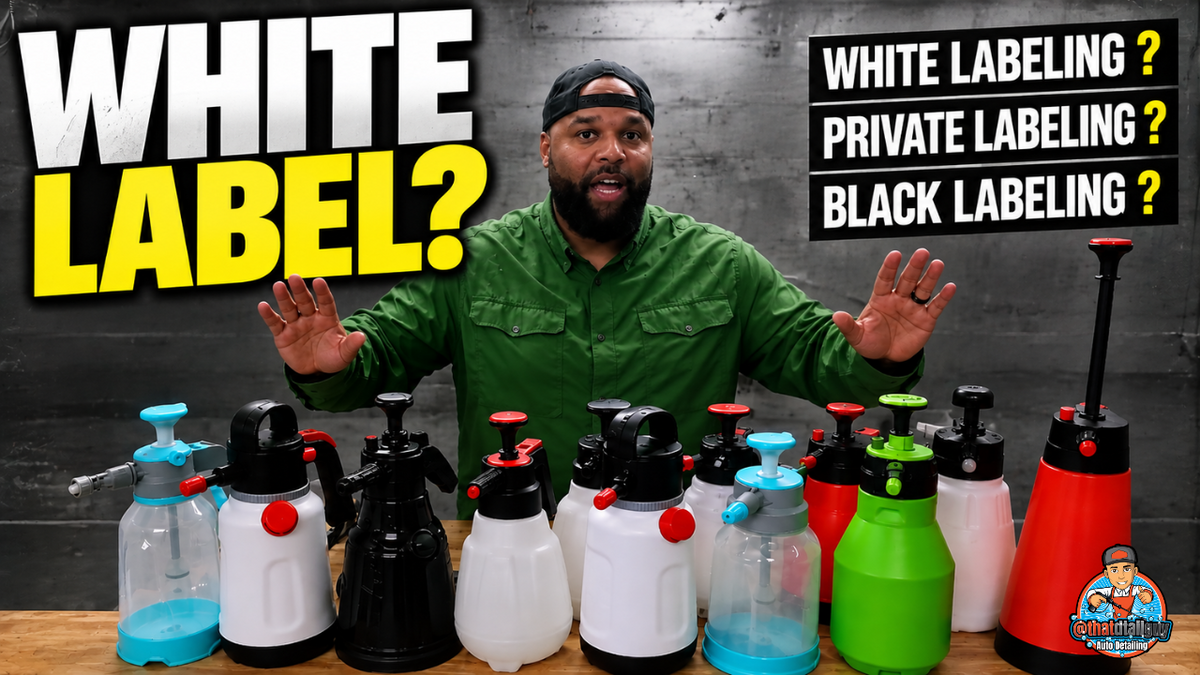
I've sold a white-labeled product. There. We can get that out of the way and have the conversation that actually matters.
Finding a familiar-looking foam cannon, towel or spray bottle on another website is not the end of the investigation. It is the beginning of a better question: What did the brand actually contribute, and does the story match the work?
I own That Detail Shop. I buy products, I test products, and I sell products under the TDS name. The TDS products discussed here are our own products, not independent recommendations. That means the standard I am talking about needs to apply to me, too.
This is not a list of companies to attack. It is a look at our own starting point, the products I decided not to sell, and the questions I think are worth asking before you spend your money with anybody.
Watch the Full White Labeling Discussion
The video shows the samples and products behind these examples. Watch the full discussion on YouTube, or use the player below.
The short version: Outsourcing is not the same as dishonesty. An original design is not automatically a good product. A premium price is not proof of quality. Tell me what you changed, what you tested and what you are responsible for. Then let the product earn its place.
White Label, Private Label and “Black Label”: Start With the Actual Work
These terms get used like they are a scoreboard. White label is bad. Private label is better. Something custom must be the best. I do not think that tells you nearly enough about the thing you are buying.
In common usage, white labeling means selling an existing supplier-made product under your own branding, usually with little product customization. Private labeling generally means a product or variation made for a particular brand, with the level of customization and exclusivity depending on the arrangement. Shopify's explanation of the two models is useful background if you want that distinction.
In the video, I also use “black labeling.” That is my own shorthand in this discussion, not a standardized industry classification or a quality certification. I use it to describe taking an existing platform and specifying meaningful upgrades without necessarily starting over with a completely new shape or mold.
Think about a pressure washer gun. The outside might look familiar, but a brand could ask for different fittings, a different swivel or another functional change. Whether those changes are useful is a separate question from whether the shell looks new.
And the reverse is true. A different-looking shell does not, by itself, prove different internals or better performance. A matching photograph does not prove two finished products have identical specifications, either.
So do not stop at the label. Ask what was selected, what was changed, what was tested and what happens if it does not work. A fancy term cannot answer those questions for you.
The Pump Sprayers I Did Not Release
The table of pump sprayers in the video is a product launch that never happened. Those are samples. I did not put our logo on them and sell them.
I had already spent a lot of time using and comparing pump sprayers before looking at our own version. I knew what I liked, what frustrated me and what I would need to improve to feel good about putting the TDS name on one.
We wanted to work with an experienced manufacturer rather than pretend we could instantly become experts in a pressurized product. But a factory having experience was not enough. I still had to be comfortable with the actual samples in front of me.
After repeated testing, I was not comfortable releasing them. I also had to ask whether we were offering a meaningful reason to buy from us instead of simply adding another logo to something already widely available.
That was a decision about those samples and our standards, not a claim that every similar sprayer is defective. And choosing to sell an existing design would not automatically have been wrong. The wrong part would have been pretending I had invented it or solved problems I had not actually solved.
Samples, shipping and time all cost money. None of that makes a product ready. Sometimes the most important part of development is being willing to say no after you have already spent the money.
A product you never release can say just as much about your standards as one you do.
Our Original Pro V1 Was White-Labeled
Our original TDS Pro V1 foam cannon was an existing product. We changed the color and added our branding. We did not redesign its internals, filtration or tubing. I am not going to turn that into a made-from-scratch origin story now.
At the time, the goal was to get a good, accessible foam cannon into the hands of our community. We were not setting out to engineer an entirely new platform. Supporting the community and raising money for charity were part of why I started down that road.
That first product also gave us something useful: a starting point we could actually use. I was detailing professionally, learning what mattered during a job and building a relationship with a manufacturer. The conversations became more specific because they were based on using the equipment, not just comparing catalog pictures.
There is a difference between saying, “We selected this product and stand behind it,” and saying, “We invented this product.” The first can be a completely honest explanation. It does not need the second story attached to it.
An honest starting point beats an impressive story that does not match what happened.
Apex and Pro V2: Development Does Not Have to Start From Zero
The lessons from that first foam cannon helped shape the TDS Apex Foam Cannon. We started asking for changes based on what we wanted the product to do and the frustrations we wanted to address.
In the video, I explain our work around filtration, metering, stability, sealing and the bottle connection. We worked with a manufacturer and an existing platform. I do not need to pretend I personally machined every component for that involvement to count.
The TDS Foam Cannon Pro V2.0 reflects another round of those decisions and community feedback. A familiar silhouette can be intentional. The question is whether the choices underneath it improve the experience you actually have when you use it.
That does not mean every revision makes a tool perfect, or that a development story proves it is better than every alternative. It means we should be able to talk about the work accurately and then demonstrate the result.
The Price Has to Be Earned
Early on, I wanted to make the best foam cannon I could at the lowest price I could manage. Over time, I started thinking more about the whole experience: what is in the box, how the product works, what the customer needs to understand and what we do if something goes wrong.
My experience has been that price changes expectations. Charge more and people expect more. Fair enough. But raising a price does not magically make the product better, and having development costs does not automatically make a price fair.
The price sets an expectation. The product and the company still have to earn it.
If you want another example of looking beyond a product's appearance, read my Suds Lab F11 vs. F1 hands-on test. The useful conversation is about what a design does during a real wash, including its limitations, not just whether it looks different.
Velocity: Compare the Complete Setup, Not Just the Tool
The TDS Velocity Mini Pneumatic Air Blaster is an example of how our thinking changed. Rather than focus only on the lowest possible starting price, we wanted a package that included the upgrades we thought made sense from the beginning.
The current Velocity listing includes the stainless steel inner cone and universal swivel fitting. In the video, I walk through the package and explain why I wanted those pieces included instead of making people chase a list of separate add-ons.
That approach also affects us as a small business. Every separately packaged accessory adds another item to stock, another box and another thing to manage. Combining useful pieces can make the offer simpler on both sides.
But “we put more in the box” is not a blank check. If you do not need the extras, a bundle might not be the right value for you. And a pneumatic tool still needs a compatible air compressor. The box is not your entire air system.
A fair comparison looks at the exact version being sold, the accessories you actually need, equipment compatibility, replacement parts and the full delivered cost. Check the current product pages rather than treating a price mentioned in a video as permanent.
The question is not just, “Which one is cheaper?” It is, “What does it cost to get the setup I need, and will it do the job?”
Towels Make the Difference Between Design and Manufacturing Easier to See
When I say TDS developed a towel, I do not think most people picture me sitting in the basement weaving it. You do not want me doing that job.
With the TDS 1400 MF Hybrid Microfiber Towel, the idea grew out of a customer request and our work with suppliers. We took that starting point and worked toward the kind of multifunction towel we wanted to offer.
That is a contribution. It is not the same job as operating the equipment that manufactures the towel. I can be responsible for the direction, the specifications we request and the product we choose to sell without pretending I physically made it.
For the buyer, I would rather talk about the task than hold a contest over the biggest number on a label. What are you wiping? How does the towel handle? What construction makes sense for that job? What care does it need? Do the stated specifications help you choose, or are they just being used to make the towel sound impressive?
I am not asking you to accept a blend or performance claim because a towel feels a certain way in my hand. The product information and the actual experience both matter. A model name or a single headline specification is not the whole explanation.
Care matters after the purchase, too. My seven-wash microfiber detergent test shows the process and judgment calls behind one of our practical towel-care comparisons.
Designing a product and manufacturing it are different jobs. You can do one without pretending to do the other.
What Does “We Make Our Chemicals In-House” Actually Mean?
This is where the conversation gets heated. We accept that a towel brand can work with a manufacturer, then sometimes treat outside help with a chemical as proof that something dishonest happened.
I think we need to be more specific. When a brand says it makes a chemical, which part is it talking about?
- Writing the brief for what the product should do?
- Developing or commissioning the formula?
- Manufacturing the liquid?
- Filling and labeling the bottles?
- Testing, setting directions and handling quality control?
Those are different contributions. “Developed in-house” and “manufactured in-house” do not describe the same thing. Neither phrase, on its own, tells me whether the product will work well for my job.
Renegade is an example I discuss in the video because it openly describes its white-label and private-label chemical services. Its own program page includes standard-product options, customization and services such as packaging and label design. You can read what it offers without guessing which unnamed brand buys from whom.
That is an example of an openly offered service, not evidence about the source of any other company's formula. A similar color, scent or bottle would not establish that two products are chemically identical.
An Outside Formulator Is Not Automatically a Shortcut
I would rather have qualified people doing the jobs they know how to do. In my view, an outside formulator can bring experience across different projects. Someone working inside a company may have a deeper understanding of that company's priorities and expectations. There can be value in either arrangement.
Neither arrangement guarantees a great product. That still has to be developed, evaluated and supported.
The problem I am talking about is more specific: choosing a standard formula and then telling customers you invented a unique formula from scratch. That is a mismatch between the contribution and the claim. It is not a reason to dismiss every product made with outside help.
Lab footage can show legitimate work. It does not establish originality or performance by itself. Show me what you contributed, then show me what the product does. That gives me something useful to judge.
Trust Should Make Questions Easier to Ask
When you follow someone, watch their videos and buy from their business, the relationship can start to feel personal. I understand that because I am on both sides of it.
But liking a person does not mean you have to buy everything they sell. It does not mean you have to defend every product, either. Something can work for another detailer and still be the wrong fit for you.
If you learn that a brand uses a supplier, look back at the claim it actually made. Did it say it selected the product? Helped develop it? Manufactured it? Invented it? Your expectation and the company's words might match, or they might not. That difference matters more than the surprise of seeing a familiar shape somewhere else.
I am not saying a brand must publish every supplier relationship or confidential development detail. I am saying it should be accurate about the work it chooses to claim. And you get to decide whether the information available gives you enough confidence to buy.
Trust should not make a reasonable question feel disloyal. It should make the conversation easier.
Support Is Part of the Value Only When It Actually Shows Up
A brand can add value through selection, instructions, consistent specifications, replacement parts and accessible help. Those are real things a buyer can care about, even when the starting platform is not exclusive.
But saying “support” in the marketing does not deliver support. A familiar name does not guarantee that nothing will fail. What matters is how a company responds when something falls short and whether the customer can reach someone who will deal with it.
A less expensive product can absolutely be the right choice. A premium can also make sense. Neither answer is automatic. If a brand charges for consistency and support, it needs to deliver consistency and support, including when there is a problem.
Before You Buy: Five Questions That Actually Matter
You do not need the internet's permission to like a product that works for you. You do deserve enough information to make a sensible decision. Here is where I would start.
- What does the brand say it contributed? Selection, specification changes, a custom design, formulation, manufacturing and support are different things. Ask for a clear explanation of the claim, not just another label.
- Can I see the product doing the job? Look for useful demonstrations, the conditions behind a comparison and feedback from people doing work similar to yours. A beautiful product video is not the same as evidence of performance.
- Are the directions and limitations clear? Check compatibility, setup, care and safety information for the exact product. This matters especially with chemicals, pressurized tools and the surfaces you are working on. Do not copy directions from something that merely looks similar.
- What is the cost of the setup I actually need? Compare the correct version, included accessories, required equipment and delivered cost. A cheap base tool can need extras; a bigger bundle can contain things you will never use.
- Who helps when something goes wrong? Read the applicable return and warranty terms, check how to contact the seller and look for relevant replacement parts or service information. An explanation of the price is only useful if the company delivers what it promises.
If an answer is vague, ask a follow-up. If a brand cannot explain what makes its version worth buying, you are allowed to choose something else. That includes us.
Frequently Asked Questions
Is white labeling automatically dishonest?
No. Selling an existing product under a brand is not the same as falsely claiming to have invented it. The important distinction is whether the company describes its role accurately and delivers the product and support it promises.
Is private label always better than white label?
No. Customization tells you something about the sourcing arrangement, not whether the finished product is better for your needs. A useful standard product can be a better purchase than a custom one that does not do its job well.
What does Gary mean by black labeling?
It is my shorthand here for specifying upgrades to an existing platform. It is not a standardized category, certification or guarantee. Ask which features actually changed and why those changes matter.
Does finding the same-looking product on a supplier website settle the question?
No. It gives you something to investigate. A photograph alone does not establish the specifications, internals, included accessories or support behind the version being sold. It also does not prove that differences exist. Those need an explanation and evidence.
Can a company develop a product without manufacturing it?
Yes. A brand can set requirements, work with specialists, evaluate samples and request revisions while another company performs the manufacturing. The claim should make that role clear rather than blur development and production together.
Does this mean I should pay more for a branded product?
Not automatically. Compare what you need, what you get and who stands behind it. A higher price needs a reason that matters to you, and the company still has to deliver on that reason.
The Bottom Line: Buy the Product, Check the Claims, Expect Accountability
One person does not have to develop, manufacture, teach and support every piece of a product for that product to be legitimate. I run a small business, and I rely on other people. Knowing when I need somebody more qualified is part of doing the job.
What I do not need is a story that makes my contribution sound bigger than it was. And you do not need to buy something just because you like me.
Buy what works for you. Look for honest claims. Hold companies accountable. White label, private label or something custom, that standard should not change.
Where do you draw the line? When a brand says “we make this in-house,” what do you expect that to mean? Join the conversation on the video.
Trust Costs Nothing.
Join the discussion