


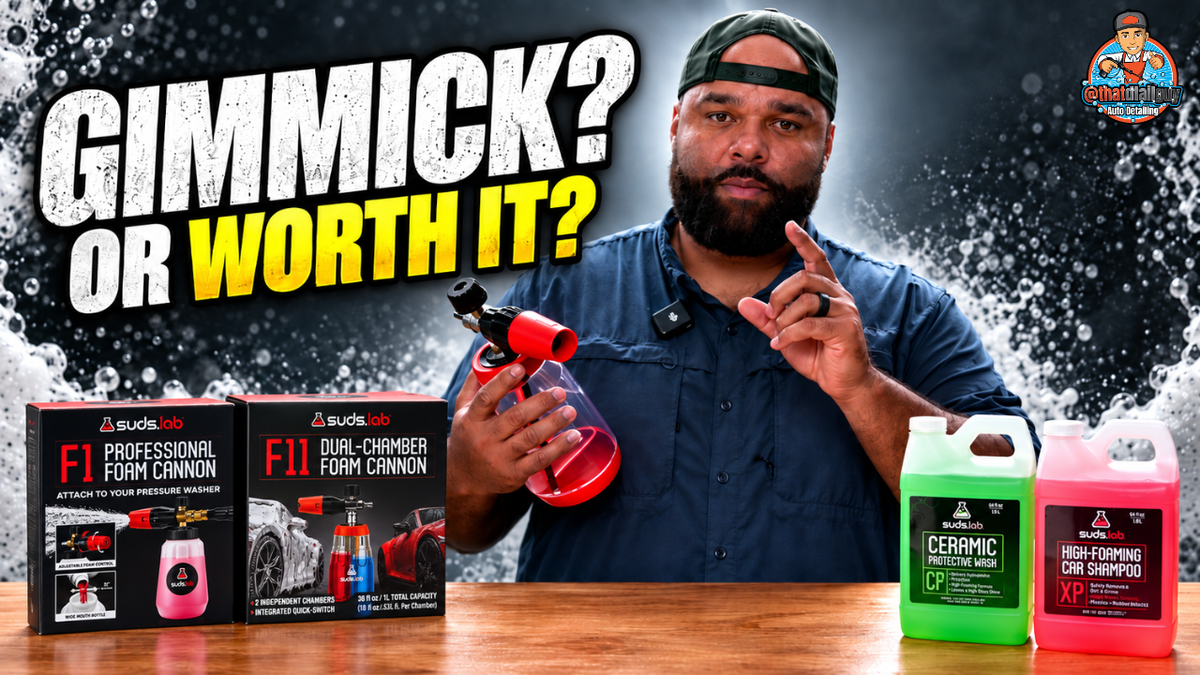
Can one dual-chamber foam cannon replace two conventional cannons, or is it another clever-looking detailing gimmick? That was the question I wanted to answer when the Suds Lab F11 showed up. Instead of filling it with a custom soap mix and judging how photogenic the foam looked, I tested it using Suds Lab's own chemicals, their label instructions, and a straightforward residential pressure washer setup. I also brought out the company's conventional F1 foam cannon to see what the extra chamber actually changes.
The result surprised me. The F11 produced impressive foam while leaving substantial amounts of solution in both chambers. But it also introduced new inconveniences, and the comparison was a practical field test—not a controlled laboratory efficiency trial. Here's what I used, what I measured, what I observed, and where I think this design makes sense.
Watch the full hands-on test: Suds Lab F11 vs. F1 foam cannon on YouTube.
Why I Tested the Suds Lab F11
I initially shared a few photos of the F11 with the r/AutoDetailing community. The conversation immediately turned to the questions worth asking: Does dividing the bottle in half make the cannon run out faster? Is switching between soaps worth the added complexity? Is there a real use case for two separate chemical chambers outside specialized two-step washing?
That feedback shaped the test. You can read the original Reddit discussion here.
Test Equipment: The Full Loadout
Equipment matters because foam-cannon performance is not determined by the bottle alone. Pressure washer flow, nozzle sizing, chemical dilution, and user technique can all change both foam quality and consumption. Here is the setup I used:
| Component | Equipment |
|---|---|
| Pressure washer | Greenworks automotive pressure washer, rated at 1.8 GPM |
| Water supply | Standard residential garden hose hookup |
| Inlet connection | 10-inch Flexzilla hose feeding the Greenworks unit |
| Pressure hose | QuivrFlex pressure washer hose (exact diameter not confirmed) |
| Spray gun | MTM Hydro SGS28 short pressure washer gun |
| Test cannons | Suds Lab F11 dual-chamber foam cannon and Suds Lab F1 conventional foam cannon |
| Orifices | Factory 1.25 mm orifice in each cannon, visually checked during unboxing |
| Chemicals | Suds Lab XP High-Foaming Car Shampoo and CP Ceramic Protective Wash |
| Measurement | Graduated measuring cups/glasses (see Valley Industries measuring pitcher as an option) and bottle graduation markings |
My other equipment and useful alternatives: The Greenworks used in the video isn't available through my Amazon links, but I also own this alternative pressure washer. For hose options, here's an UBERFLEX kink-resistant pressure washer hose (an alternative to the QuivrFlex I tested). Other helpful hose accessories include POWER TOWN 3/4-inch GHT stainless quick-connect fittings, a 304 stainless two-way garden hose splitter, and a 6-pack of quick-connect hose fittings. Those options aren't all verified as components of this particular test.
Important: The 1.8 GPM figure is the pressure washer's stated specification, not an independently measured flow rate during this test. I did not record measured pressure at the gun, water temperature, water hardness, or actual flow through the cannon. Those variables would matter in a stricter performance comparison.
Suds Lab F11 vs. F1: What You Get for the Money
At the time of testing, I saw the F11 priced at approximately $49.99, compared with about $29 for the standard F1. The F11 was later discounted to around $33.99 during Prime Week. Those are observed prices at the time, not guaranteed current prices.
| Feature | F11 Dual Chamber | F1 Conventional |
|---|---|---|
| Container arrangement | Two independent chambers, approximately 18 oz each | Single reservoir, approximately 32 oz |
| Nominal total capacity | Approximately 36 oz combined | Approximately 32 oz |
| Factory orifice observed | 1.25 mm | 1.25 mm |
| Chemical switching | Selector switches between A and B | Change solution or swap cannons |
| Filling | Two narrower chamber openings | One conventional opening |
| Price observed | $49.99 (later $33.99 promotion) | Approximately $29 |
On paper, the F11 isn't simply a foam cannon with half the capacity. Its total container capacity is comparable to—and nominally larger than—the F1. The trade-off is that neither individual chemical chamber gets the entire bottle.
Build Quality, Packaging, and Design Details
Before spraying anything, I spent time with the physical products. Suds Lab's packaging was a standout. The contrast of matte and gloss surfaces, the positioning of the labels, and the protective inserts all communicated that someone had thought through the retail experience. The packaging also protects parts that could otherwise puncture the carton.
On the F11, the chamber alignment and head assembly are particularly clever. The top rotates independently, allowing the container to attach properly without fighting the position of the dual-chamber selector. The A/B switching mechanism is simple to understand. The bottle felt substantial in hand, its measurement markings were legible, and the included metal filter assemblies were better than I expected at this price.
I also appreciated how intentionally the nozzle and front label were oriented on the two models. These sound like small things, but manufacturing a product that consistently looks right when assembled requires attention to tooling and component alignment.
Both units had orifices marked 1.25 mm. I would personally prefer stainless-steel orifices, but the brass components are an understandable cost decision. An orifice's material alone does not establish foam quality or service life; those require longer-term evaluation.
Testing Methodology: Manufacturer Instructions First
Here's where my approach differed from a lot of quick foam-cannon demonstrations. I did not replace the factory orifices, optimize a homemade dilution recipe, or turn down the output just to stretch the solution further. The goal was to ask a more useful question: Do Suds Lab's own chemicals work well with Suds Lab's own hardware when you follow their stated dilution guidance?
The F11 has two separate chambers. Since the normal soap instructions are written for a conventional full-size reservoir, I divided the recommended chemical amounts roughly in half for the individual chambers. I selected the upper end of the suggested ranges to give the products an opportunity to perform well. That is an adaptation of the printed directions for this bottle design, not a manufacturer-published F11-specific mixing chart.
Chemical Preparation
| Test mixture | Concentrate used | Water added | Notes |
|---|---|---|---|
| F11 chamber A: XP shampoo | 3 fl oz | Approximately 15 fl oz | Based on halving the higher-end conventional foam cannon dose |
| F11 chamber B: CP ceramic wash | 2.5 fl oz | Approximately 15 fl oz, adjusted during filling | Adapted from the recommended dilution range |
| F1 comparison | Manufacturer-directed mixtures prepared for the standard bottle | Measured during the video | Used for practical, not perfectly identical, comparison runs |
The exact fill levels required minor adjustments. I also accidentally got a small amount of chemical into the neighboring F11 chamber while pouring. That wasn't planned, but it highlights a real limitation of the design: the shared bottle opening is divided, making precise filling less forgiving than with a conventional cannon.
One technical note worth stressing: the amount of concentrate put in a reservoir is not the final chemical concentration reaching the paint. A foam cannon draws and dilutes that solution into the pressure washer water stream. We did not directly measure the cannon's chemical draw ratio, so the prepared bottle dilution should not be confused with the final panel dilution.
Field Results: Foam Quality and Remaining Solution
Once the cannons were on the car, the F11 impressed me immediately. Foam production was substantial and coverage was excellent. The real surprise came when I stopped and checked how much mixture remained in the separate chambers after covering the vehicle.
| F11 observation | Measured or estimated amount |
|---|---|
| Chamber containing ceramic wash | Approximately 200 mL remaining (about 6.8 US fl oz) |
| Other chamber | Just under 9 US fl oz remaining |
| Relative to nominal 18 oz per chamber | About 38% and just under 50% remaining, respectively |
That's substantial remaining capacity. It directly challenges the assumption that a divided reservoir necessarily leaves you short of solution after a single vehicle. Depending on vehicle size and application technique, there may have been enough remaining for additional coverage. I would not claim a guaranteed second full vehicle without actually performing and measuring that additional run.
What Happened with the F1?
With the F1, I got carried away on the first application because the foam looked so good. I ended with around 1.5 oz remaining. Then I made another run while deliberately trying to be more mindful of usage. The amount remaining on that later run was just over half an ounce.
That is a useful real-world observation, but there's an important qualification: these were not tightly controlled consumption trials. I did not establish identical starting volumes, measure spray duration to the second, hold trigger behavior constant, or quantify the coverage area for every pass. So it would be wrong to turn the F11's remaining fluid into a specific percentage efficiency improvement over the F1.
What I can say is that, in this testing, the F11 delivered plenty of foam without exhausting its two smaller chambers. Its output characteristics and practical solution use were more favorable than I expected.
Why Metering Matters More Than Foam Photos
Very thick foam is visually impressive. That doesn't automatically mean a cannon is efficient, delivers the right concentration, or cleans better. A foam cannon can look fantastic while rapidly draining expensive product. Another can create plenty of usable foam with far less reservoir draw.
Fluid consumption depends on the pressure washer's operating conditions, the cannon's metering and air-mixing hardware, nozzle configuration, adjustment settings, and the prepared solution. Chemical viscosity can matter too. Because the F11 and F1 share the same stamped orifice size, their different practical results are a reason to investigate the rest of the system—not proof that an orifice marking alone tells the whole story.
A rigorous follow-up would collect and weigh the discharged solution or measure reservoir mass before and after a fixed spray interval, repeat each run, then compare the amount used per minute and per unit of vehicle coverage. That would distinguish genuine equipment efficiency from operator technique.
The Big Advantage: Two Chemicals, One Cannon
At first glance, this feels like a specialty tool for detailers performing alkaline and acidic pre-wash sequences. That's a reasonable use case, but it may not be the one that matters to most buyers.
For everyday enthusiasts, the stronger argument is convenience. Imagine keeping your cleaning shampoo in one chamber and a compatible ceramic wash or protection-oriented soap in the other. You select the product you need without disconnecting the cannon, emptying a bottle, or installing a second foam cannon.
That can simplify a wash routine, particularly when the alternatives are owning two separate cannons or repeatedly rinsing and refilling the same one. The actual time savings will depend on your workflow; this test did not produce a standardized stopwatch comparison.
Where the F11 Falls Short
1. Filling Two Chambers Takes More Care
The divided opening means two separate pours, two chemical measurements, and a greater chance of spilling into the wrong side. You can absolutely work with it, but it is less straightforward than filling a wide-mouth single bottle. A funnel or precise pouring cup would help.
2. Each Chemical Has Less Individual Capacity
The combined bottle capacity sounds generous, but if you only want to use the product in chamber A, chamber B's capacity doesn't help. A user applying a single solution to multiple large vehicles may prefer one uninterrupted reservoir.
3. The Chemical Pairing Is Not Obvious Enough
I actually had to think harder than expected about which two Suds Lab chemicals belonged together in the F11. For a product with such a distinctive two-chamber concept, an obvious manufacturer-recommended two-product workflow would make the experience much easier to understand—particularly for beginners.
4. Compatibility Should Not Be Assumed
Separate chambers allow you to store different solutions before application, but that does not automatically validate every acid, alkaline cleaner, or protection chemical for the internal seals and materials. Compatibility, dwell time, safe rinsing, and manufacturer guidance still matter. Never assume that two chemicals are safe to combine simply because a cannon can switch between them.
Who Should Buy the Suds Lab F11?
The F11 makes the most sense for someone who regularly switches between two appropriate foam-compatible products and wants a reasonably priced, self-contained solution. It is also interesting for enthusiasts who enjoy trying new, functional detailing equipment without jumping into premium-tool pricing.
The F1 may still be the better choice for someone who uses one soap every wash, needs the simplest possible fill process, or prefers having the full reservoir available for a single product. You don't need to pay for a second chamber if you won't use it.
Final Verdict: Innovation or Gimmick?
After using both cannons, I don't see the F11 as just a novelty. The rotating assembly and selector serve a real purpose. Foam quality was strong, and the amount of solution left after coating the vehicle was genuinely surprising. The product also appears thoughtfully engineered and priced for mainstream users rather than only the premium detailing niche.
Is it perfect? No. Filling the chambers takes more care, and I think Suds Lab could do a much better job of teaching customers exactly which two chemicals to use together. And I wouldn't pretend this single field test proves a universal efficiency advantage over every conventional foam cannon.
But at the roughly $49.99 price I observed during testing, the F11 offers a convincing combination of useful innovation, build quality, and value. At the Prime Week price I later saw, the proposition looked even stronger.
I initially considered a separate Chem-X Stars + Stripes test but decided to keep this video focused on Suds Lab's own system. That would make a worthwhile follow-up with clearly defined rinse and application steps.
Frequently Asked Questions
Does a dual-chamber foam cannon run out of soap faster?
Not necessarily. Each side of the F11 has less individual capacity, but in this test both chambers retained considerable solution after the vehicle was covered. Actual consumption depends on the mixture, metering, pressure washer, and how you spray.
How much solution did the F11 have left?
Approximately 200 mL remained in one chamber, while the other had just under 9 fl oz. Based on 18 oz nominal chamber capacity, that corresponds to roughly 38% and just under 50% remaining.
What pressure washer was used?
A Greenworks automotive pressure washer rated at 1.8 GPM, connected to a standard residential water supply and an MTM short gun using a QuivrFlex pressure hose.
What size orifices did the F11 and F1 have?
Both factory orifices were marked 1.25 mm. I kept them stock for testing.
Can the F11 be used with acid and alkaline products?
The two separate reservoirs make multi-product routines appealing, but you should confirm chemical and material compatibility with the manufacturers and follow product-specific handling and rinse instructions. This video did not complete a dedicated acid/alkaline compatibility test.
Is the F11 worth the extra money over the F1?
If you'll use both chambers, the switching convenience can justify the additional cost. If you only ever foam with one shampoo, the simpler and less expensive F1 remains a sensible option.
Equipment and Affiliate Links
Affiliate disclosure: As an Amazon Associate, I earn from qualifying purchases. The links below may earn a commission at no additional cost to you.
The Greenworks 1.8 GPM pressure washer and QuivrFlex hose were used during testing. The linked alternative pressure washer is one I own but did not use in this test; the UBERFLEX hose and accessories are optional alternatives.
- Suds Lab F11 Dual-Chamber Foam Cannon
- Suds Lab F1 Professional Foam Cannon
- Suds Lab XP High-Foaming Car Shampoo
- Suds Lab CP Ceramic Protective Wash
- MTM Hydro SGS28
- 10-inch Flexzilla hose
- Alternative pressure washer (owned separately)
- UBERFLEX alternative pressure washer hose
- POWER TOWN 3/4-inch GHT stainless quick-connect fittings
- 304 stainless two-way garden hose splitter
- 6-pack quick-connect hose fittings
- Valley Industries measuring pitcher
Join the Discussion
Have you tried a dual-chamber cannon? What two chemicals would you actually keep loaded? I'd also love to know which product you want to see put through the same kind of practical test next.
See the original Reddit conversation or watch the complete field test.
Testing transparency: The F11 was supplied by Suds Lab, while the F1 and additional testing products were purchased separately. Observations and conclusions are my own. This was a real-world demonstration, not a certified laboratory test.
Join the discussion